Smart Lens Treatment: Clear Vision Without Glasses is Now Possible

Although wearing glasses is a natural part of daily life for many people, it can become tiring over time, especially for those with near vision impairment (presbyopia), cataracts or those who need different glasses for both near and far. the search for “clear vision without glasses” starts at this point. Smart lens treatment, which we have heard frequently in recent years, is a modern approach that can offer both the treatment of cataracts and the correction of visual defects under the same roof in suitable patients. This technology, popularly known as “smart lens”, actually refers to advanced intraocular lens (IOL) options implanted into the eye.
In this article, we will discuss in detail the most curious questions such as what is a smart lens, how is smart lens surgery performed, what are the differences between options such as trifocal lens and multifocal lens, who it is suitable for or who it may not be suitable for. In addition, we will transparently explain the factors affecting the price instead of clear figures on smart lens prices and share practical tips for those who are looking for Istanbul smart lens and Bahçelievler smart lens. Remember: The most accurate plan is customized after a comprehensive eye examination and measurements.
What is a smart lens (intraocular lens)? For which complaints does it offer solutions?
Smart lens is the popular name given to specially designed intraocular lens options that replace the natural lens of the eye and can support vision at multiple distances (near-medium-far). It is most commonly used during cataract surgery to remove the natural lens that has lost its transparency and replace it with a new lens. However, it can also be considered in suitable candidates who do not have cataracts, but want to reduce their dependence on glasses for presbyopia treatment (near vision impairment).
Smart lens treatment may be considered in the following cases:
- Blurred vision, light scattering, fading of colors due to cataract
- near vision impairment (presbyopia)** starting after the 40s and the need to constantly change glasses
- The necessity to wear glasses for both near and far (especially for people who work actively and use computers)
- Cases accompanied by astigmatism in appropriate patients (at this point thoric smart lens options can be evaluated)
An important note of realistic expectation here: While smart lenses can strengthen the goal of “glasses-free vision”, 100% glasses-free cannot be guaranteed. Some people may benefit from a low prescription, especially under conditions such as prolonged close reading, very small print or dim light. Nevertheless, with the right patient selection and correct lens planning, a significant reduction in spectacle dependence is targeted.
Trifocal lens, multifocal lens and EDOF: Which one is more suitable for whom?
Smart lenses should not be understood as a single product, but as multiple lens designs selected according to different needs. The most commonly discussed options are trifocal lens, multifocal lens and EDOF lens (extended depth of focus) designs that may be preferred in some patients. The choice is based on lifestyle, frequency of driving at night, computer/phone use, reading habits, eye structure and measurement results.
Brief comparison (general framework)
- Trifocal lens: Targets near-medium-far distance together. It stands out for those who want computer distance and practicality in daily life.
- Multifocal lens: Near and far focus can be more pronounced; some designs also support mid-distance.
- EDOF lens: Aims to provide a more “fluid” field of vision at distance and intermediate distances; for near, some people may need a thin support lens. For those who are sensitive to light scattering at night, it may be an option with a doctor’s evaluation.
Halo-glare and adaptation
One of the most curious aspects of smart lenses is the complaints of halo/glare (ring around lights, sensitivity to glare), which can be seen especially in the first period. This situation varies from person to person. While some patients adapt in a short time, it may take longer in some patients. For this reason, lens selection is more meticulous for people who say “I drive frequently at night”; expectations are clearly discussed.
For astigmatics: Toric smart lens
If the patient has significant astigmatism, both presbyopia and astigmatism correction can be targeted in the same session by planning thoric smart lens instead of standard smart lens. Measurement accuracy (biometrics, corneal analysis) is critical here.
Tip: there is no single correct answer to the question “**Trifocal lenses or multifocal lenses are better?”. the “better” option is the one that best suits your eye structure, your expectations and your daily life.
Who is suitable for smart lenses and who may not be suitable for smart lenses? (Eligibility criteria)
The most important step for a successful smart lens treatment is the selection of the right candidate. Because no matter how good the lens is, if there are problems in other structures of the eye (cornea, retina, macula, tear film), the results may not be as expected.
Who might it be suitable for?
- People with cataracts who also want to reduce their dependence on glasses
- Candidates who are uncomfortable with near glasses due to presbyopia and who are found suitable in the examination
- People who wear both near and far glasses and lead active lives
- Patients with astigmatism who can be appropriately planned with toric options
Who may not be suitable for (must be evaluated by a physician)?
The following conditions may not be a “definite obstacle” for smart lenses; however, the decision is made more carefully, sometimes different types of lenses or a different treatment plan is recommended:
- Severe dry eye and significant ocular surface problems (may affect measurement accuracy and comfort)
- **Conditions that disrupt the corneal structure such as irregular astigmatism, keratoconus
- Retinal/macular diseases (e.g. macular degeneration, diabetic retinal involvement)
- Some problems with the optic nerve
- People with high light sensitivity and significant anxiety during night driving
What tests are performed during the examination?
the answer to the question “Who will be treated with smart lenses?” is determined by comprehensive measurements. Frequently:
- Biometry (lens power calculation)
- Corneal topography/tomography (corneal curvature and astigmatism analysis)
- Retinal evaluation
- If necessary, dry eye assessment and tear tests are performed.
At this stage, your physician realistically evaluates your goal of “glasses-free vision” and recommends the most suitable lens type for you.
How is smart lens surgery performed? The recovery process and things to watch out for
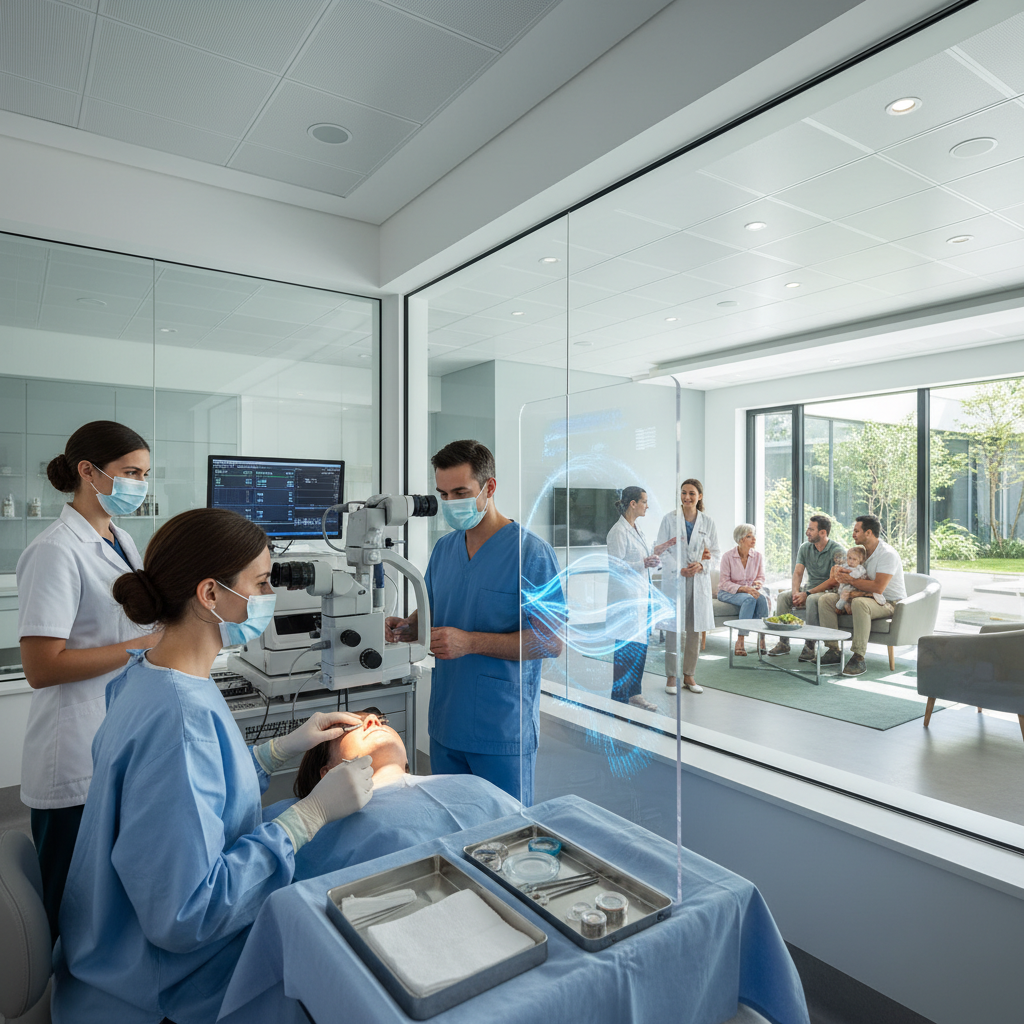
Smart lens surgery often uses the same technical infrastructure as cataract surgery. It is usually performed under drip anesthesia and the duration of the procedure varies depending on the patient, but is usually short. Same day discharge after surgery is a common practice (may vary according to the physician’s plan).
Step-by-step process (outline)
- Preliminary examination and planning: Lens type (trifocal lens, multifocal lens, EDOF lens, toric smart lens) and number are calculated.
- Operation day: Drop anesthesia is applied, the planned lens is placed into the eye.
- Controls and drops: Drop therapy is arranged to reduce the risk of infection and edema, and a control schedule is planned.
First days after surgery: What is normal?
- Mild stinging, watering, wavy vision in the first days
- Sensitivity to light
- Variable vision during the day (especially during the adaptation process)
Back to everyday life: Practical advice
- Use your drops on time; do not miss check-up appointments.
- Avoid rubbing the eye in the first few days; observe hygiene rules.
- the question “When can I drive after smart lenses?” depends on the individual; visual clarity and doctor’s approval are decisive.
- Computer/phone use should generally be planned in short intervals and in a way that does not increase dry eye.
Possible risks and side effects (transparent information)
As with any surgical procedure, there are risks involved in smart lens treatment. Most frequently discussed:
- Halo/glare, decreased contrast sensitivity
- Residual number (need for a small spectacle)
- Capsule opacification over time (can be corrected with YAG laser in some patients)
- Rare but serious risks such as infection (risk is reduced by sterile surgery and follow-up)
The most effective way to reduce these risks is the right candidate selection, accurate measurement and experienced surgical planning.
Smart lens prices, treatment planning in Istanbul and Bahçelievler + FAQ
How do smart lens prices vary?
“Smart lens prices” is one of the most searched topics; however, it is often not accurate to say a clear price in health services. The main factors affecting the price:
- Lens type selected: trifocal lens, multifocal lens, EDOF lens, thoric smart lens
- Whether one eye or two eyes is planned
- Required audits and measurement technologies
- Hospital infrastructure, sterilization standards and surgical team experience
- Package scope (check-ups, medicines, additional procedures, etc.)
In addition, the answer to the question “**is the smart lens covered by SSI?” may vary according to the diagnosis (such as the presence of cataract), institutional agreements and application details. The healthiest approach is to receive personalized information after the examination.
Tips for those looking for smart lenses in Istanbul and Bahçelievler
there are many options when searching for Istanbul smart lenses, so look not only at price but also at the following criteria when choosing:
- Scope of measurements performed during the examination (biometry, topography, retinal evaluation)
- Physician’s explanation of lens options with pros and cons (especially night vision and adaptation)
- Clarity of the postoperative follow-up plan
for those looking for Bahçelievler smart lenses, ease of transportation, appointment scheduling and sustainability of postoperative controls can provide significant advantages.
Frequently Asked Questions (FAQ)
**Is smart lens treatment permanent? The lens placed inside the eye is permanent; however, regular check-ups are important as other structures of the eye may change with age.
**Are cataract surgery and smart lens the same? Cataract surgery is the removal of the clouded natural lens. Smart lens refers to the type of lens chosen for this surgery (or for the treatment of presbyopia in appropriate cases).
**Smart lens or laser? This comparison depends on eye structure, number, corneal thickness and age. While some people are suitable for laser, for others a smart lens may be a better option.
**How long does halo last after smart lens? It depends on the person. It decreases in a short time in some patients; adaptation may take longer in some patients. This issue must be discussed before lens selection.
Eye health directly affects overall quality of life. If you suffer from cataracts or are tired of constantly changing glasses due to presbyopia, smart lens treatment may be a suitable option for you. A comprehensive examination and individualized planning are essential for the most accurate response.
Meanwhile, other issues related to facial aesthetics and the eye contour are also frequently wondered about. For example, some patients may want to improve the appearance around the eyes while increasing visual comfort. At this point, the content of Eyelid Aesthetics: A Younger, Vigorous and Vital Look may give you an idea. Within the scope of general health goals, issues such as weight control also support quality of life; you can also take a look at Obesity Treatment: Permanent Weight Loss and Safe Step to Healthy Living .